
Overview
Points are only worth what a participant can turn them into. Redemption Options are the set of rewards you make available in the Redemption Center, and the Redemption Ratio controls how many points each one costs.The Redemption Ratio
The Redemption Ratio is how many points make one dollar of redeemable value. It is a single whole number, set on the Reward Bank extension, and it applies to every Redemption Option in that bank. The default is1, so one point is worth one dollar. Set it to 10 and ten points are worth one
dollar — a 2,500-point balance redeems for $250. Raise the number and points buy less; lower it and
points buy more.
You also set Redemption Minimum Value and Redemption Maximum Value, the smallest and
largest monetary amount a participant can redeem at one time. Align the maximum with the limit your reward provider enforces.
Setting either to 0 disables it.
For how to choose the number, see
Choosing Your Point-to-Reward Ratio.
Reward Options
Coupons and promotional codes: Single-use codes uploaded in batches, or static codes. Best where you want redemption to drive another purchase. See How to Reward with Coupons. Account credits and store credit: Value applied to the participant’s account in your own system. Extole tracks the credit and your systems apply it. See How to Reward with Account Credits. Gift cards: A wide range of gift card and cash-like rewards through Extole’s reward providers, including open-loop and closed-loop cards. See How to Reward with Tango Gift Cards and Sending Rewards with Tremendous. Charitable donations: Participants direct their points to a cause instead of taking value themselves. Physical products: Fulfilled by you rather than by Extole. Configure a custom reward, and Extole records the redemption and hands it to your fulfillment process. Exclusive access and experiences: Early access to a product release, an invitation, or a members-only offer. There is no packaged reward type for this. Build it either as a custom reward that your systems act on, or by placing redeemers into an audience that gates the experience on your side.A reward that you fulfill yourself — a physical product, an experience, an invitation — is a
custom reward. Extole issues and records it; the delivery happens in your systems.
Program Models
The same components support several program shapes. Choose the one that matches how much control you want participants to have.Choose Your Reward
Participants accumulate points and pick from a catalog of Redemption Options when they are ready. This is the model the Reward Bank is built around, and it gives participants the most control. Deferred redemption also spreads reward cost over time rather than paying it out at the moment of earning.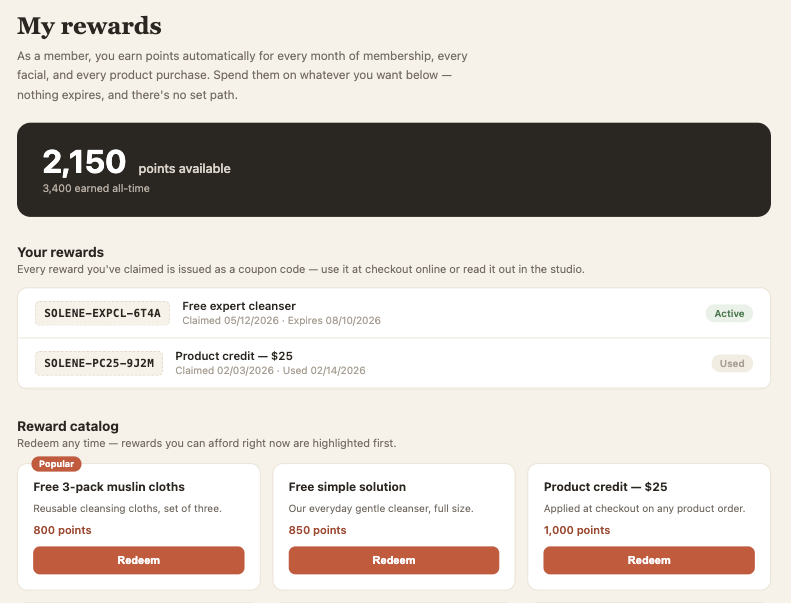
A Choose Your Reward member experience: a running point balance, the rewards already claimed, and a catalog priced in points.
Automatic Issuance
Participants accumulate points, and each time the balance reaches a set threshold a reward issues automatically — every 500 points becomes a $10 coupon, or every $500 spent returns a $20 coupon. There is no catalog and no redemption step, but the participant still watches a balance build toward the next reward, so the program keeps the progress that makes points motivating. Use this where you want the simplicity of a single predictable reward rather than a catalog, or where your audience will not reliably come back to redeem.Automatic issuance is not a checkbox on the Reward Bank extension. Extole configures the rule
that converts a balance at the threshold, so ask your Extole contact to set it up rather than
looking for it in the extension.
Tiered Earning
Participants can earn at different rates by tier, and a tier can also unlock Redemption Options. Tiers based on subscription: Paid members can receive a higher point multiplier, exclusive rewards, or both, while every participant can still earn on the same activities. You can send that status as a profile attribute or as audience membership. Tiers based on activity: A program can offer a higher earning rate at a higher status, and can keep the balance a participant spends separate from that status. Reward rules can issue a different value for participants in different tiers, and a campaign can be targeted to a tier. See Tiers and Member Status.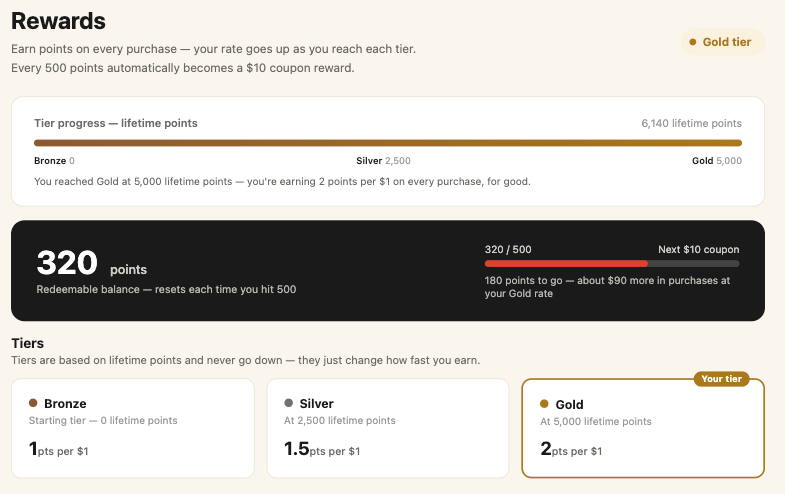
A member page can show tier progress, a redeemable balance, and an earning rate for each tier.